2. How to use the Johari Window to uncover blind spots
Most adults assume they fully understand themselves, yet there are always parts of our behaviour or personality that are visible to others but hidden from us. These are called blind spots. Blind spots can subtly affect your decisions, relationships, and personal growth.
The Johari Window is a simple but powerful tool that helps uncover these areas and allows you to see yourself more clearly through the eyes of others. Using the Johari Window is not about criticism. It is about learning and growth. By recognising your blind spots, you can adjust behaviour, improve communication, and strengthen relationships.
Imagine a colleague repeatedly misunderstands your instructions, or friends comment that you seem distant during conversations. Without awareness, you may think this is everyone else's problem. With the Johari Window, you have a framework to identify patterns, see your blind spots, and make conscious changes that benefit both you and the people around you.
Why this matters
Blind spots influence how others perceive you and how you perform. Ignoring them can lead to:
- Misunderstandings in relationships
- Missed career opportunities
- Repeated personal mistakes
- Stress and frustration
Being open to feedback and learning to explore blind spots creates trust, improves communication, and increases personal and professional growth. Feedback, when received constructively, is a gift, not a threat.
A realistic example
Sibongile works as a team leader in Johannesburg. She noticed that her team often seemed hesitant in meetings. They nodded politely but rarely spoke up. She initially thought the team lacked confidence.
Using the Johari Window, she asked her colleagues for feedback. They shared that Sibongile often interrupted before team members could finish their thoughts. This was her blind spot. She had no idea her behaviour was affecting participation.
Sibongile reflected on this feedback and made a small adjustment: she started pausing and inviting input from quieter team members. Over a few weeks, engagement increased, and she noticed her own stress levels decrease.
Understanding the Johari Window
The Johari Window was created in 1955 by psychologists Joseph Luft and Harrington Ingham. The aim was to help people understand interpersonal communication and self-awareness. The name comes from combining their first names: Jo for Joseph and Hari for Harrington.
The model divides personal awareness into four quadrants:
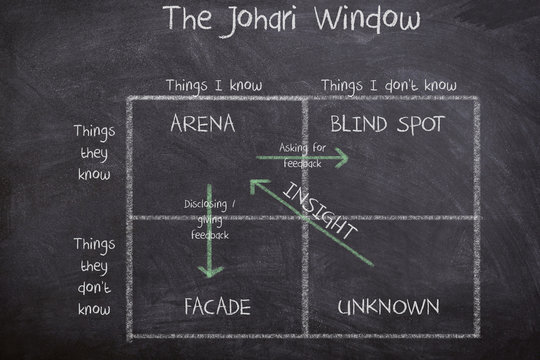
- Open Area (Arena)
- Traits, behaviours, or skills known to both you and others
- Example: You are dependable and organised, and everyone sees that
- Expanding this area builds trust. Share relevant thoughts, skills, and feelings to increase transparency
- Blind Area (Blind Spot)
- Traits others see but you do not
- Example: Interrupting others without realising it
- Reducing this area requires honest feedback and reflection
- Hidden Area (Facade)
- Traits you know but keep hidden from others
- Example: Personal insecurities or ambitions you do not share
- Gradually disclosing information to trusted people builds deeper relationships and reduces internal stress
- Unknown Area
- Traits unknown to both you and others
- Example: Hidden talents, untapped potential, or responses to new situations
- Exploring this area involves trying new experiences, taking on challenges, and reflecting on outcomes. Mentoring or coaching can reveal hidden strengths
Expanding the open area while reducing blind spots and hidden traits strengthens self-awareness, relationships, and decision-making. Exploring the unknown area opens opportunities for growth.
Free tools and opportunities available
You do not need expensive programmes or coaching to build self-awareness with the Johari Window. Many effective tools are freely available:
- Google Docs or Notes – Create a simple list of your traits and update it as you get feedback
- Google Forms or Typeform – Collect anonymous feedback from colleagues, friends, or family
- MindTools Johari Window worksheet – Free downloadable template for mapping your quadrants
- Daylio or Moodnotes apps (free versions) – Track daily behaviours and compare with feedback patterns
- Public libraries and community learning centres in South Africa – Access books and free resources on communication and self-awareness
Practical exercise: Use the Johari Window
This week, you will apply the Johari Window to uncover your blind spots.
Step 1. Create your list of traits
Write 10 words or short phrases describing yourself. Include strengths, habits, and behaviours.
Step 2. Ask 3–5 trusted people for feedback
They should list traits they see in you without knowing your self-assessment.
Step 3. Map the quadrants
- Traits on both lists → Open Area
- Traits they listed but you did not → Blind Spot
- Traits you listed but they did not → Hidden Area
- Unknown traits → Usually emerge over time
Step 4. Choose one blind spot to explore
Reflect on how it affects your interactions and decisions.
Step 5. Take a small action
Adjust your behaviour in a manageable way this week and observe the results.
Recommended books and references
- Joseph Luft & Harrington Ingham – The Johari Window
Original book introducing the model and practical applications in interpersonal communication. - Tasha Eurich – Insight
A research-based guide on increasing self-awareness and understanding blind spots. - Stephen Covey – The 7 Habits of Highly Effective People
Explains proactive self-awareness and focusing on what you can influence. - Daniel Goleman – Emotional Intelligence
Explores how awareness of emotions and behaviours affects relationships and success.
Small action for this week
Complete the Johari Window exercise with at least two trusted people. Focus on one blind spot and test a small behaviour change.
Call to action
Share one insight you discovered about yourself or how feedback helped you see a blind spot. Your experience may inspire others to explore theirs.
What comes next
Next week, we will explore Emotional Intelligence in real life, including practical ways to recognise, manage, and use emotions to improve decisions and relationships.
